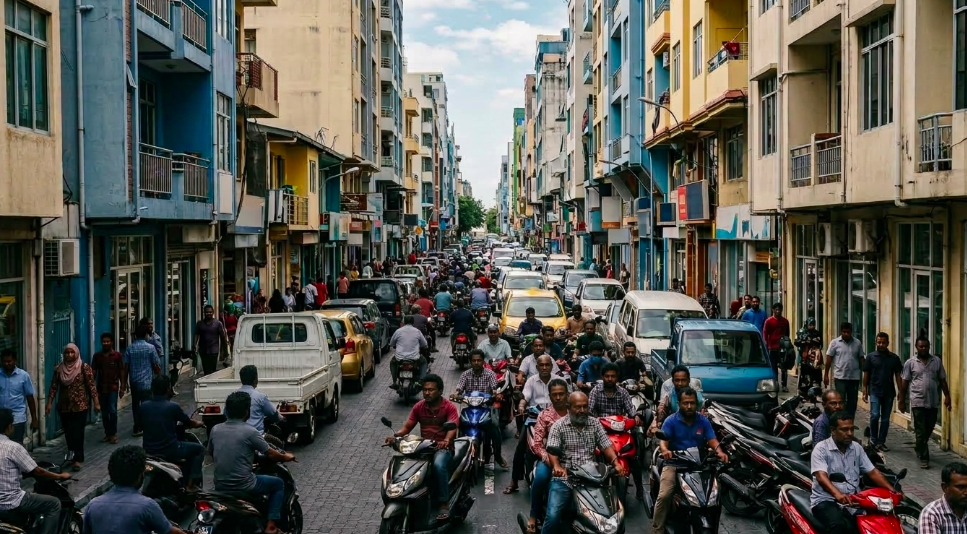

The vehicle density in the Greater Malé region has surged past some of the world's most populous megacities, reaching an extraordinary 15,800 vehicles per square kilometer, according to official statistics released by the Ministry of Economic Development, Transport and Trade.
This staggering ratio highlights an unprecedented congestion crisis on an international scale. By land area, the concentration of registered vehicles in Malé is six times higher than in New York City, eight times higher than in Tokyo, and 13 times higher than in Singapore.
Official data shows that 130,806 vehicles currently operate across the capital area, comprising 115,895 motorcycles and 14,911 four-wheeled vehicles. Relative to the city's resident population, this translates to approximately one motorcycle for every two people. The rapid influx has continued unabated, with more than 8,000 motorcycles and over 2,000 cars and vans registered in 2023 alone.
The spatial footprint of this vehicular boom has severely restricted urban mobility. While the capital area encompasses 8.30 square kilometers of roads, a striking 82 percent of that space is consumed by moving traffic and parked vehicles, leaving just 18 percent accessible for pedestrian movement.
Unlike major global hubs that effectively curb vehicle ownership through extensive modern public transit networks and strict quota regulations, the Maldives has yet to implement comparable containment policies, allowing street-level gridlock to worsen with each passing year.