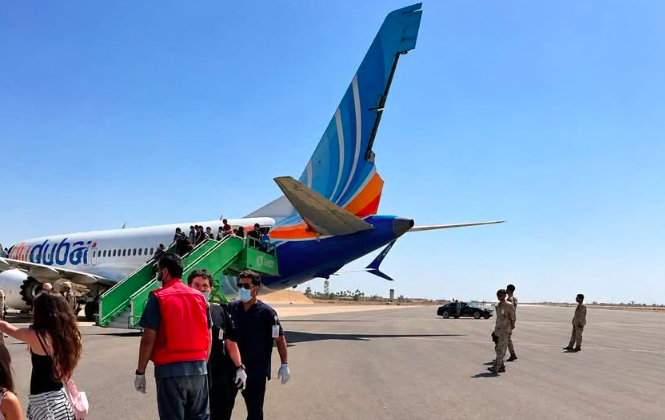

On September 30, 2026, the history of commercial aviation witnessed a chilling episode of mid-air terror that was ultimately thwarted by an extraordinary display of human resilience. Flydubai flight FZ1073, a Boeing 737 MAX 8 carrying over 170 passengers and crew, departed Dubai International Airport in the early hours of the morning bound for Tel Aviv. What began as a routine journey across the Middle East rapidly descended into a nightmare scenario, testing the limits of airline security and the profound courage of those on board.
Approximately two and a half hours into the flight, while cruising high above the airspace of Saudi Arabia, the unimaginable occurred inside the locked confines of the cockpit. The flight's co-pilot, identified as 29-year-old Omani national Hamam al-Hammami, suddenly turned on the aircraft's commanding officer. Armed with the plane’s emergency crash axe, al-Hammami launched a violent, targeted assault on Captain Smit Machchhar, a highly experienced Indian aviator. The attacker's objective was clear: incapacitate the captain, seize control of the flight instruments, and force the aircraft out of the sky.
As the brutal struggle unfolded, the aircraft lost its stable flight path and entered a steep, terrifying dive. In less than a minute, the Boeing 737 plunged between 14,000 and 17,000 feet, plunging the cabin into absolute chaos as oxygen masks deployed and the aircraft's systems blared warnings. During this harrowing descent, the flight transmitted critical distress signals to air traffic control—first squawking 7700 for a general emergency, followed quickly by 7500, the universal aviation code for unlawful interference and hijacking.
Despite suffering severe and bleeding injuries from the axe blows, Captain Machchhar demonstrated phenomenal composure and grit. Drawing on his nearly 9,750 hours of flying experience, he fought to maintain whatever control he could while making a split-second, life-saving decision. In a desperate bid for survival, the wounded captain managed to reach the security controls and unlock the fortified cockpit door, an act that would prove to be the turning point of the crisis.
The moment the lock disengaged, the cabin crew and a group of fast-acting passengers rushed into the cockpit. The chaotic scene saw civilians—including Israeli passenger Yaniv Hayun—and flight attendants risking their lives to physically overpower the armed co-pilot. Through sheer collective force, they managed to restrain and disarm al-Hammami, neutralizing the immediate threat of a catastrophic crash.
With the attacker subdued, the aviation community's unwritten brotherhood shone through. Off-duty pilots traveling as passengers stepped forward to assist the critically injured captain in stabilizing the battered aircraft. A reserve pilot took over the controls, successfully executing an emergency diversion to Tabuk Airport in Saudi Arabia. Against all odds, the plane touched down safely. While the aircraft sustained some structural damage, not a single life was lost among the 170-plus people on board, and Captain Machchhar was rushed to emergency medical care, where he is now recovering.
As the dust settled on the runway in Tabuk, chilling details regarding the suspect began to surface, prompting severe scrutiny of regional aviation security. Investigations revealed that al-Hammami had a documented history of radicalization. He had previously been employed by Oman Air for roughly seven years before being quietly removed from flying duties in 2024. Sources familiar with the matter confirmed he was grounded and moved to an administrative role due to deeply concerning extremist views and the possession of radical materials, before eventually graduating with a distance-learning aviation management degree from the UK's Buckinghamshire New University.
The revelation that a pilot with flagged extremist ties was able to secure a position at another major carrier has sent shockwaves through the industry. Al-Hammami had been hired by Flydubai merely eight to nine months prior to the incident, clearing vetting protocols to operate flights, including those to Israel—a nation with which his home country of Oman holds no formal diplomatic relations. This glaring failure in intelligence sharing and background screening has ignited demands for a sweeping overhaul of inter-airline communication regarding personnel threats.
The incident is now the subject of a massive, multi-national investigation led by the United Arab Emirates. UAE Attorney-General Counsellor Dr. Hamad Saif Al Shamsi formally classified the cockpit assault as an attempted "terrorist act," confirming that the suspect actively sought to crash the plane. Echoing this severity, Israeli officials, including Prime Minister Benjamin Netanyahu, characterized the event as a jihadist attack driven by Islamist radical indoctrination. The suspect has since been extradited from Saudi Arabia to the UAE, where authorities are probing his motives, digital footprint, and any potential accomplices.
In the immediate aftermath, Flydubai suspended all flights to and from Tel Aviv, and the broader aviation sector has been forced into a harsh reckoning regarding the vulnerabilities of the very people trusted to fly. Yet, amidst the systemic failures and the terrifying reality of the attack, the legacy of flight FZ1073 is one of profound heroism. The collective bravery of an unyielding captain, decisive crew members, and fearless passengers transformed a guaranteed tragedy into a miraculous story of survival.