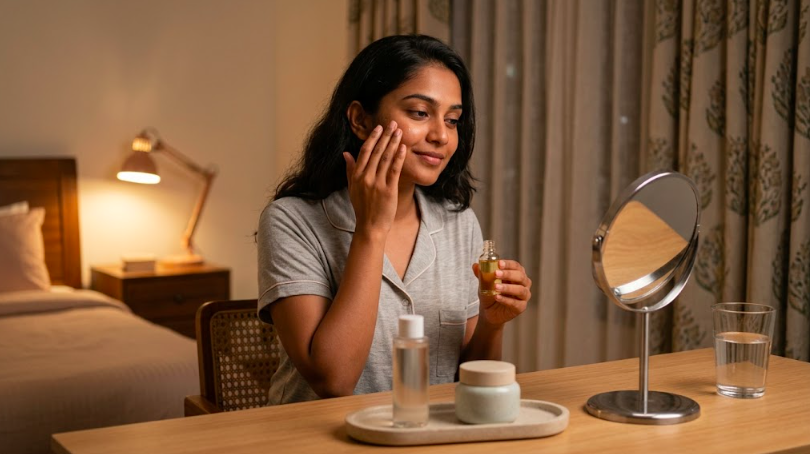

A minimalist skincare shift known as the "barrier-glaze" routine is rapidly replacing dense, occlusive night creams with cold-pressed squalane oil. Focused on sealing moisture without suffocating the skin, the technique involves layering a few drops of plant-derived squalane over lightweight hydrating serums or damp skin as the final step in an evening routine.
For decades, the standard response to dry, compromised skin barriers was applying heavy moisturizers loaded with petrolatum, mineral oils, or thick waxes. While these create an impenetrable film, they frequently trap dead cells, trigger congestion, and cause breakouts—especially for those with acne-prone or combination skin. Squalane solves this trade-off because it closely mimics squalene, a lipid naturally produced by human sebaceous glands. Because the skin recognises its molecular structure, squalane sinks in effortlessly rather than resting as a suffocating surface film.
The barrier-glaze method works by mimicking the intercellular matrix of the stratum corneum:
True Biomimicry: Squalane is fully hydrogenated, rendering it shelf-stable, oxidation-resistant, and non-comedogenic while replenishing the natural lipid balance lost to environmental stress or over-exfoliation.
Trans-Epidermal Seal: When patted over humectants like hyaluronic acid or glycerin, squalane locks in water molecules without creating the greasy, pore-clogging barrier typical of synthetic balms.
Universal Compatibility: Unlike standard facial oils that can disrupt unbalanced skin, squalane self-regulates across oilier and sensitive complexions, calming redness without triggering excess sebum production.
Dermatologists point out that skin functions best when it can repair itself unimpeded overnight. By switching from thick formulations to a featherweight, bio-compatible oil glaze, the barrier-glaze routine delivers deep hydration and a natural morning sheen without the breakouts or heavy residue of traditional night creams.