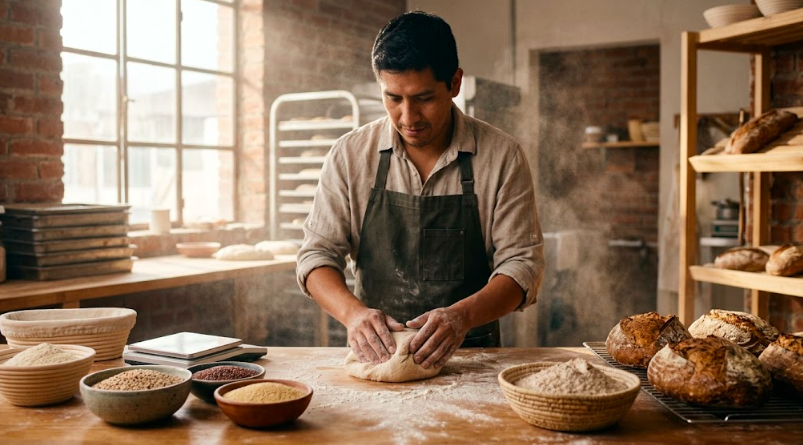

An ecological culinary movement is taking root across Latin America, where artisan bakers are reviving ancestral Andean heirloom grains to spearhead a zero-waste bread revolution. By substituting commercial, monoculture wheat flours with resilient heritage grains—including quinoa, amaranth, kaniwa, and kiwicha—bakers are creating deeply flavourful, nutrient-dense breads while eliminating byproduct waste across every stage of milling and fermentation.
Cultivated for millennia throughout the high-altitude Andean highlands, these crops were historically prized by Inca and pre-Inca societies for their exceptional nutritional profiles and drought tolerance. In modern commercial milling, refining grain strips away the bran and germ, discarding valuable micronutrients and generating massive agricultural food waste. In contrast, the zero-waste baking movement treats the entire grain as an indispensable resource:
Whole-Crop Utilization: Grains are stone-milled whole on-site to preserve naturally occurring vitamins, minerals, and wild yeasts, ensuring no portion of the kernel is sifted out or discarded.
Byproduct Upcycling: Leftover coarse hulls, grain washings, and milling chaff are repurposed into active sourdough starter feeding routines, fermented flatbreads, and aromatic broths rather than ending up in municipal landfills.
Soil and Climate Resilience: Sourcing directly from regional smallholders supports regenerative farming practices in high-altitude communities, preserving soil biodiversity and cutting transport emissions compared to imported processed flours.
Beyond sustainability, the movement addresses culinary performance. The complex starches and varied gluten structures of Andean heirloom seeds require specialised long-fermentation cycles, resulting in complex, nutty flavour profiles and naturally digestible sourdough loaves.
As food waste remains a major driver of global carbon emissions, Latin America's artisan bakeries demonstrate that the path forward lies in ancestral wisdom. By wedding circular, zero-waste principles with ancient agricultural heritage, bakers are demonstrating that modern sustainable food systems can begin right at the mixing bench.