
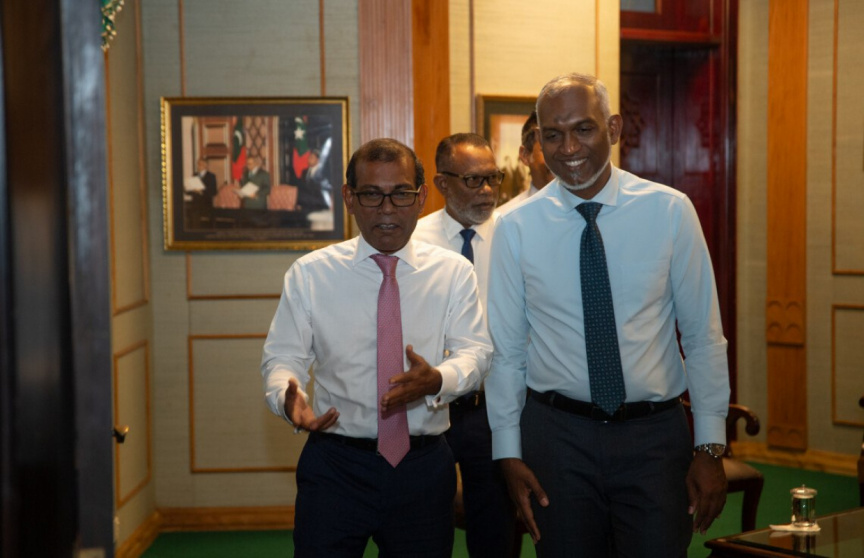
Former President and Chairperson of the main opposition Maldivian Democratic Party (MDP), Mohamed Nasheed, has urged party members not to oppose the government's decision to award a landmark $20 billion residency tourism development project in Rasmale' to UAE-based developer Eagle Hills. Addressing concerns raised within the party's National Council WhatsApp group regarding the mega-venture, Nasheed explicitly expressed his backing, describing the high-profile initiative as a genuinely beneficial development for the Maldives.
Dismissing political criticism attempting to link Eagle Hills founder Mohamed Alabbar to Israel, Nasheed clarified that there is no justification for tying the prominent Emirati developer to the Zionist movement. Nasheed noted that while Alabbar holds personal acquaintances in Israel, he has been an instrumental figure in building the United Arab Emirates and is not an agent advancing Israeli or Zionist interests. The former president cautioned that adopting a narrow-minded perspective on major developmental endeavors would ultimately cause political harm to the party.
According to a joint statement released by the Ministry of Construction and Infrastructure and Eagle Hills, the multi-phase $20 billion agreement marks the largest single foreign direct investment in Maldivian history. The development plan across Rasmale's "Urban Area" features a waterfront marina, ultra-luxury residential properties, international hotel resorts, world-class dining outlets, a waterfront promenade, and dedicated leisure and wellness centers designed to attract affluent global travelers and residents.
Economic projections indicate that the venture will channel more than $30 billion in foreign investments into the Maldives over its lifecycle, encompassing an estimated $18 billion in net direct investment. Additionally, project planners anticipate that the waterfront destination will generate roughly 54,000 employment opportunities across multiple service sectors, substantially strengthening national economic diversification.
Eagle Hills further projects that the development will draw over one million visitors annually once operational, generating upwards of $2 billion per year in tourism-driven receipts from the designated development zone alone. The initiative remains a central pillar of the current administration's long-term urban expansion and economic roadmap, despite mounting public debate and opposition scrutiny surrounding foreign development concessions.