
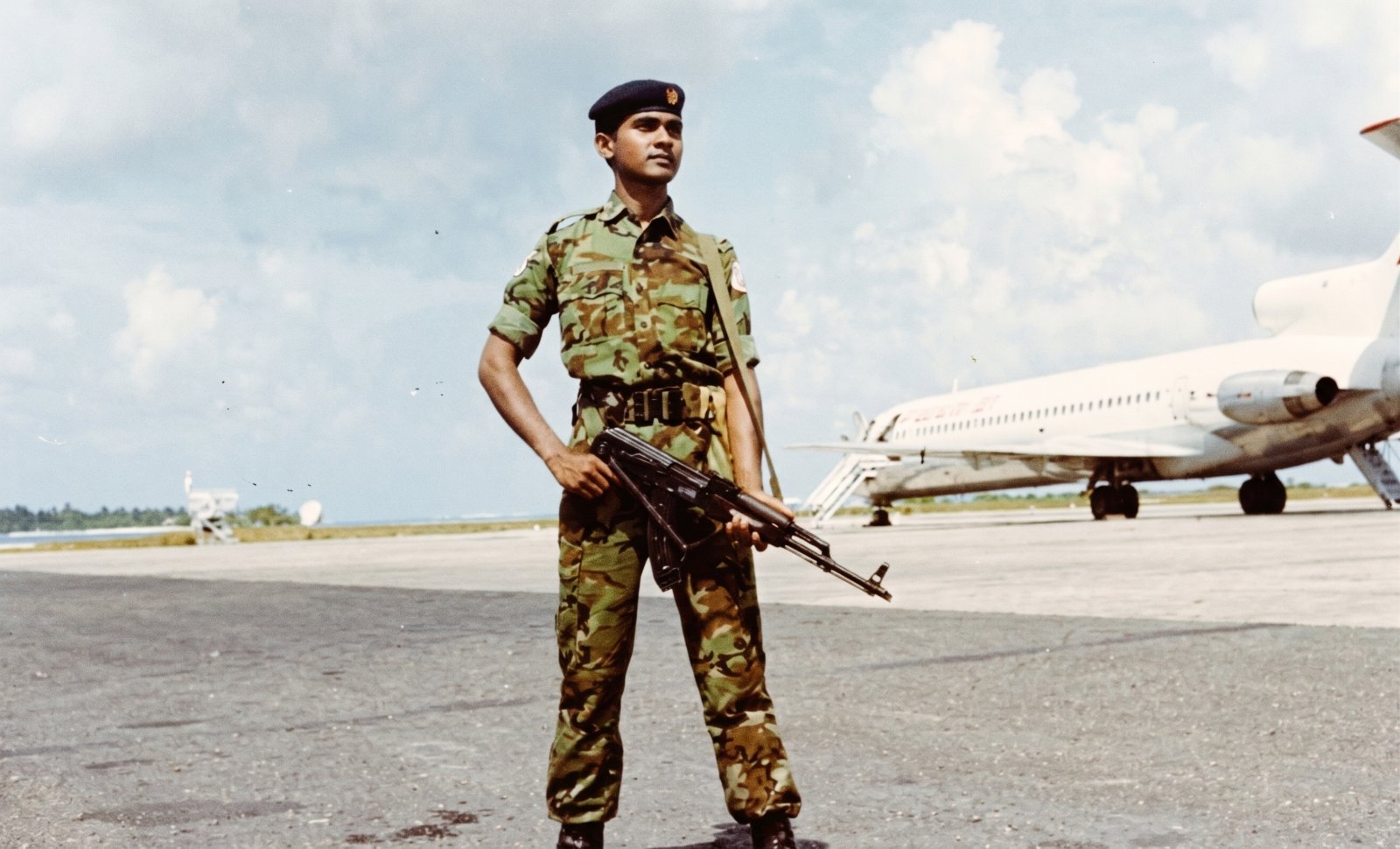
In the pre-dawn stillness of November 3, 1988, the capital island of Malé lay completely vulnerable. At 4:20 AM, silence was shattered by rapid automatic rifle fire and rocket-propelled grenades as roughly 80 heavily armed mercenaries from the People’s Liberation Organisation of Tamil Eelam (PLOTE), guided by Maldivian conspirators, stormed the streets. Their primary target was clear and catastrophic: the headquarters of the National Security Service (NSS). Capturing the garrison meant seizing the central armory, neutralizing the state’s sole armed defense, and effectively securing control of the country within minutes.
Standing directly between the invasion force and that objective was a single 20-year-old soldier: Corporal Hussain Adam.
The Linchpin of the Invasion
The conspirators’ battle plan relied entirely on speed, shock, and total surprise. With no advance intelligence available to the state, the attackers planned to blow open the exterior gates of the NSS headquarters, flood the compound, and overwhelm the garrison while officers were still asleep.
Stationed inside the small sentry post at the outer gate, Corporal Hussain Adam had mere seconds to evaluate the sudden assault. Protocol and human instinct in the face of insurmountable odds might have dictated seeking cover or attempting an immediate retreat into the interior courtyard. Instead, Adam shouldered his service rifle and engaged the forward elements of the mercenary force head-on.
The Tactical Stand
The engagement that followed lasted approximately five minutes—a brief window on a clock, but an eternity under concentrated heavy fire.
Halting the Advance: Operating from within the exposed sentry booth, Adam returned steady, disciplined single shots and bursts. Confronted by immediate, accurate counterfire, the lead mercenaries hesitated, mistaking the lone sentry post for an entrenched forward defensive platoon.
Buying Crucial Time: That hesitation broke the coup’s offensive momentum. Inside the headquarters, the initial volley had awakened the garrison. Hearing Adam actively engaging the hostile force outside gave the commanding officers the exact window required to realize an invasion was underway, rally personnel, and sound general quarters.
Securing the Garrison Gates: While Adam held the attackers at bay, soldiers inside managed to reach the heavy steel perimeter gates, securing and barricading them from within before the militants could breach the threshold.
"Ammunition! Ammunition!"
As the mercenaries concentrated their automatic fire, grenades, and rocket rounds directly on the sentry post, concrete and shrapnel tore through the booth. Adam continued firing until he expended his magazines. Surviving accounts from that morning recall his desperate shouts across the compound wall calling for additional ammunition ("Vazan! Vazan!").
With the outer gate heavily bolted from inside and the courtyard raked by crossfire, there was no safe avenue to resupply him. Adam held his position until his final round was spent. Moments later, having absorbed multiple direct hits while preventing the gates from falling, he succumbed to his injuries.
The Cascade of Failure
Though Adam fell, those critical five minutes altered the entire trajectory of the invasion:
Denial of the Armory: Because the NSS gates were locked and barricaded, the mercenaries never gained access to the nation’s heavy weapons and defense reserves.
Loss of Tactical Initiative: Denied a rapid entry, the attackers were forced into protracted street-level skirmishes around the perimeter, burning daylight and ammunition without securing the state's military core.
Preserving Government Continuity: The delay allowed key personnel to move President Maumoon Abdul Gayoom to a secure safehouse, enabling him to establish contact with international partners and officially request urgent defense assistance.
Enabling Intervention: By nightfall, Indian paratroopers touched down under Operation Cactus at an uncompromised Hulhulé Airport, securing the capital and routing the remaining mercenary force within hours.
Had the outer gate fallen in the initial 4:20 AM rush, Malé’s central defensive position would have collapsed before any counter-response could be mounted. Corporal Hussain Adam’s singular stand transformed an open gateway into an impenetrable roadblock, securing his place as the defining hero of Victory Day and proving that the fate of an entire nation can hinge on five resolute minutes.