
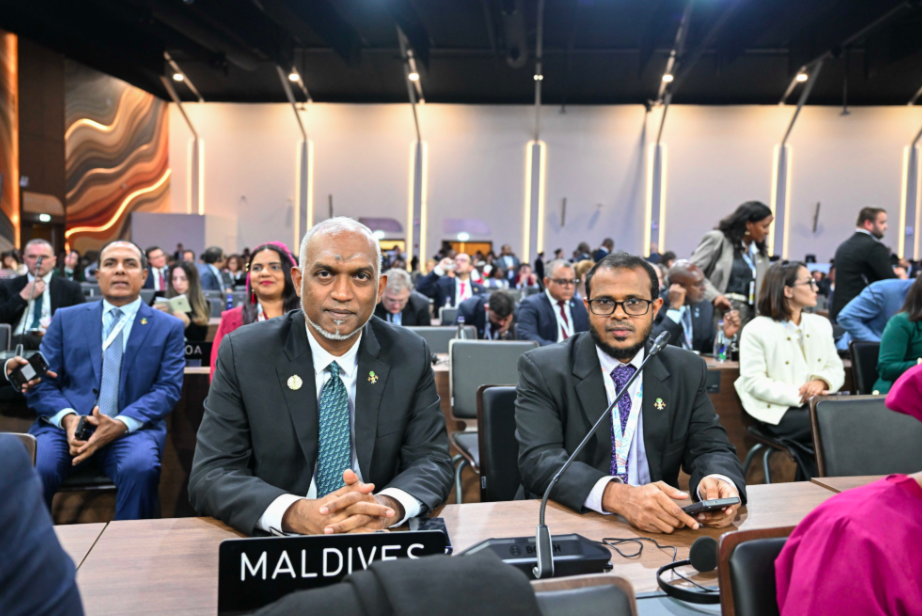
At the 31st Conference of the Parties to the United Nations Framework Convention on Climate Change (COP31), the Republic of Maldives delivered an uncompromising assessment of global climate multilateralism: declarations without implementation are failing the world’s most vulnerable states. Delivering the Maldives' National Statement, President Dr. Mohamed Muizzu urged the international community to move decisively beyond rhetoric and transform long-delayed pledges into practical, measurable outcomes. The statement established a clear operational blueprint anchored on three core pillars: concessional and grant-based climate finance, structural multilateral reform, and direct implementation.
A central imperative of the Maldivian intervention was the urgent restructuring of global climate finance architecture. Small Island Developing States (SIDS), despite contributing negligibly to global greenhouse gas emissions, face an existential crisis exacerbated by standard financing instruments. President Muizzu stressed that climate finance must be predictable, additional, and fundamentally grounded in grants rather than sovereign loans. Forcing vulnerable frontline nations to take on high-interest sovereign debt to recover from externally driven environmental disasters creates an unsustainable cycle of fiscal vulnerability and climate exposure.
In tandem with restructuring debt dynamics, the Maldives called for substantial capital injections across core multilateral funding mechanisms. The statement demanded scaled-up replenishments for the Green Climate Fund (GCF) and the Adaptation Fund to match the accelerating pace of global climate disruption. Furthermore, the Maldives emphasised that the Loss and Damage Fund must be fully operationalised with accessible, immediate-release capital, ensuring that post-disaster resources reach vulnerable communities without bureaucratic paralysis or prohibitive conditionalities.
Beyond fund replenishment, the Maldives advocated for an overhaul of international financial institutions (IFIs) and global credit rating frameworks. Current credit assessments frequently penalize small island nations for natural hazard exposure, driving up borrowing costs precisely when capital is required for defensive infrastructure. President Muizzu noted that international rating agencies and multilateral lenders must recalibrate how they assess climate investments. Resilience projects must no longer be treated as fiscal liabilities or cost centres; rather, they represent essential value preservation and investments in collective global stability.
Demonstrating national accountability alongside international advocacy, the Maldives highlighted its domestic achievements in optimising limited resources. Despite severe geographical and fiscal constraints, the country continues to execute national programs safeguarding food, clean water, and energy security. The Maldives also achieved a regional milestone with the recent accreditation of its first National Direct Access Entity by the Green Climate Fund—making it the first Asian SIDS to secure this status. This achievement demonstrates that local institutional capacity is primed to absorb, deploy, and monitor multilateral climate funds transparently and effectively.
Emphasising that funding must translate into real-world resilience, the Maldives called for expedited clean technology transfers alongside genuine political commitment from industrialised economies. The statement reinforced that international frameworks must protect the sovereignty of small island states, enabling them to direct their own developmental priorities rather than conforming to rigid, externally imposed criteria. Concluding the address, President Muizzu underscored that the survival of global multilateralism depends on tangible justice and accountability: fulfilment of obligations is not charity, but the essential prerequisite for collective global survival.