
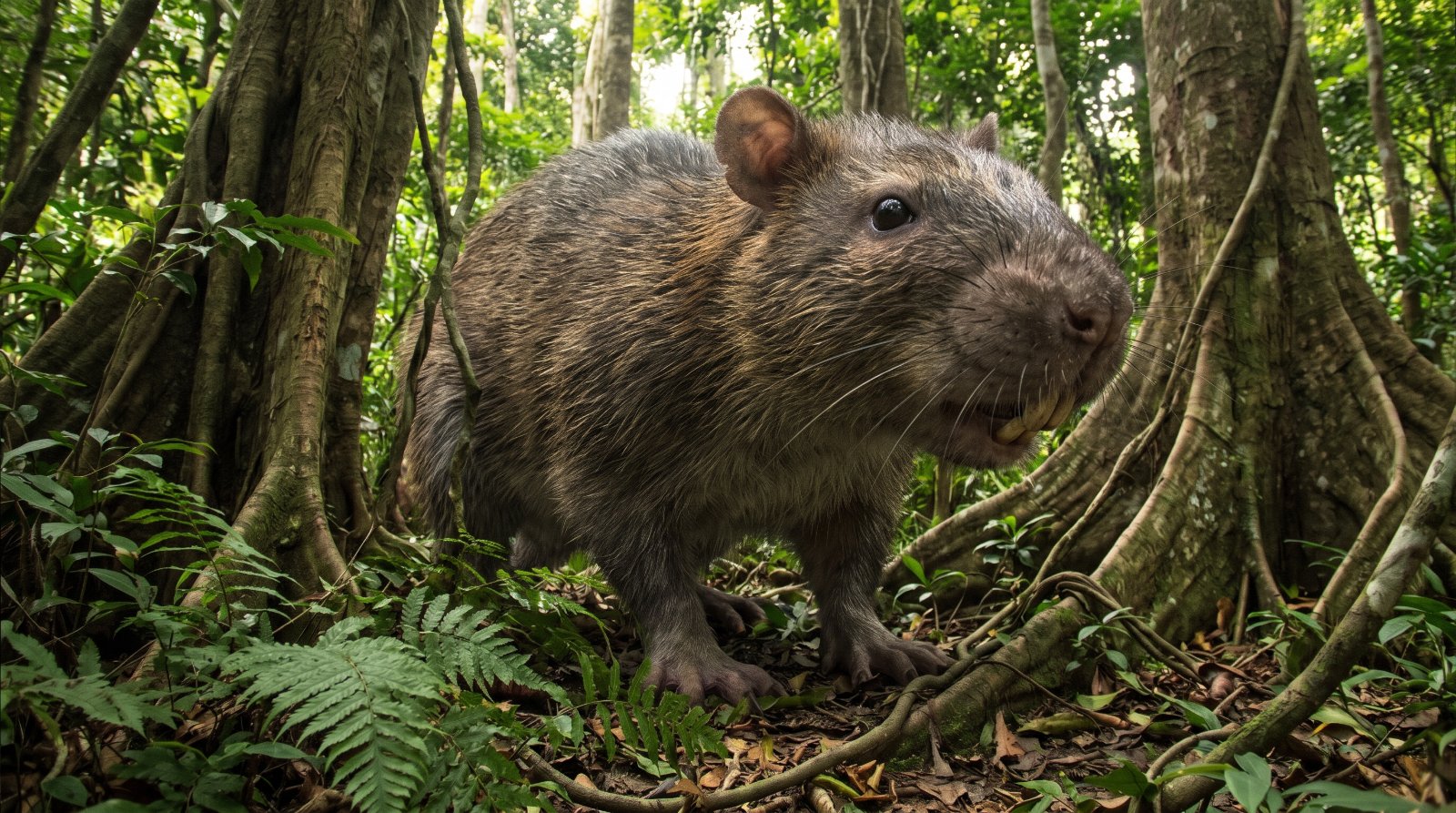
An international team of paleontologists has identified a new species of prehistoric giant rodent that weighed approximately 30 kilograms (66 pounds) and roamed Southeast Asia around 34 million years ago. The creature, roughly the size of a medium-to-large dog, represents the heaviest known rodent from the Paleogene period and indicates that extreme body size among rodents evolved millions of years earlier than previously believed.
The newly identified species has been named Yakamys sirindhornae, blending the Thai word yak (giant) with the Greek mys (mouse or rat). The species name honors Thailand’s Princess Maha Chakri Sirindhorn in recognition of her longstanding support for scientific and paleontological research. The findings were published in the peer-reviewed journal Scientific Reports.
The discovery originated from fossilized dental specimens—a large dark molar and an intact, roughly two-inch curved incisor—recovered from a lignite mine located in Krabi province, southern Thailand. Field geologist Pannipa Tian, with Thailand’s Department of Mineral Resources, initially suspected the incisor was a standard bone fragment before laboratory cleaning and microscopic enamel analysis revealed it as the tooth of an extinct member of the Ischyromyidae family.
Researchers from McGill University, Thailand's Department of Mineral Resources, France's CNRS, and the Université de Poitiers used seven established dental dimension models to reconstruct the creature’s mass. At an estimated 30 kilograms, Yakamys was more than twice as heavy as any contemporaneous rodent discovered from that epoch, matching the mass of North America's Manitsha tanka while featuring a distinct, highly specialized molar structure adapted for tough tropical vegetation.
Until now, scientists widely believed rodent gigantism was primarily restricted to much later periods in South America, where animals like the massive Josephoartigasia eventually evolved. According to the research team, this Thai discovery proves Southeast Asia served as an early evolutionary crucible for large-bodied mammals, pushing the timeline of rodent gigantism back by 15 to 20 million years.