
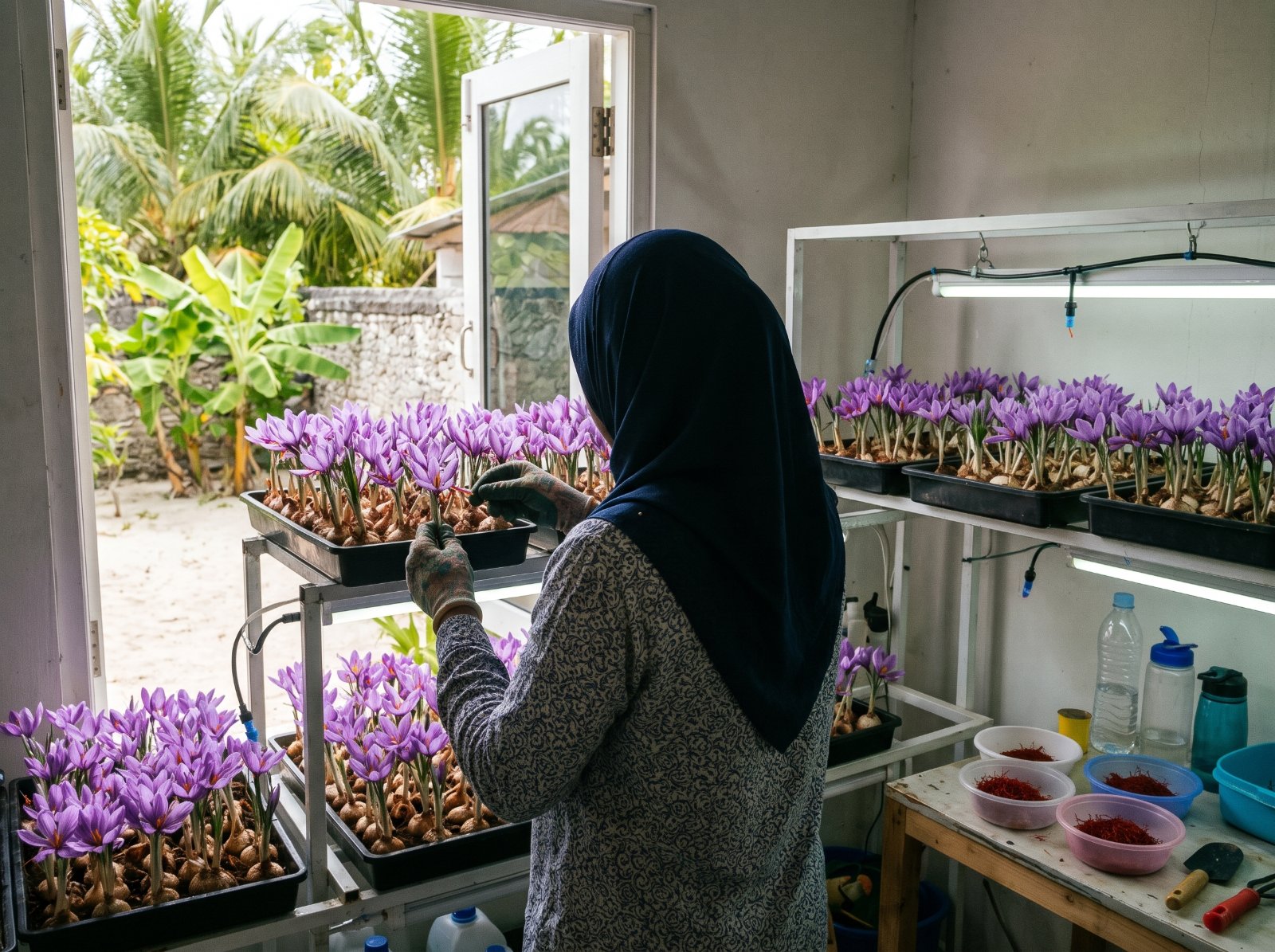
An Indian couple from Nagpur has turned a tiny 400-square-foot room into a flourishing indoor agricultural venture, defying traditional farming constraints to cultivate high-value saffron and generate over $53,000 (roughly MVR 816,900) in annual revenue. Akshay Holey and his wife, Divya Lohakare Holey, founders of Shaya Enterprises, have successfully replicated Kashmir's cold, dry climate inside their home using a soil-less farming method known as aeroponics, where plant roots are suspended in the air and misted with water and nutrients.
Before pivoting to agriculture, Divya worked in a government bank while Akshay managed a wholesale garment business and restaurants. Looking for a high-value, non-perishable crop they could grow indoors, the couple was inspired in 2018 by Divya’s Canada-based brother, who shared how common home and backyard cultivation was there. This sparked their journey, leading them to spend three-and-a-half months in Kashmir in 2019 to study traditional cultivation from local growers before conducting a successful DIY trial with 100 saffron bulbs (corms) in an 80-square-foot room back home in 2020.
Encouraged by their early trial, where over 80 percent of the test bulbs flowered, they invested approximately $66,000 (around MVR 1.01 million) into climate-control equipment, special lighting, and Kashmiri corms to scale up to a 400-square-foot facility. Over five years, their business has generated a total of over $158,000 (MVR 2.44 million) in revenue, maintaining an annual run rate of ₹40–50 lakh ($48,000 to $60,000 / MVR 740,000 to MVR 925,000). Saffron requires a seasonal cycle from August to December for harvesting, after which the couple spends the rest of the year propagating and maintaining the bulbs, which multiply naturally over time.
Their indoor-grown saffron sells for around $7,600 (MVR 117,000) per kilogram, with their combined production—including partner growers—reaching 45 kilograms last year. "The equipment has a lifespan of 20 to 25 years, and the saffron bulbs multiply, yielding harvests year after year, making this a highly sustainable and profitable long-term venture," Akshay noted.
Beyond managing their own harvest, the couple has built a training and buyback ecosystem, charging a nominal fee to train over 150 aspiring growers across Maharashtra. Under their buyback model, they purchase the saffron harvested by these partner farmers, handling the packaging, branding, and distribution themselves, which has effectively expanded their market footprint while empowering a new wave of indoor micro-farmers.