
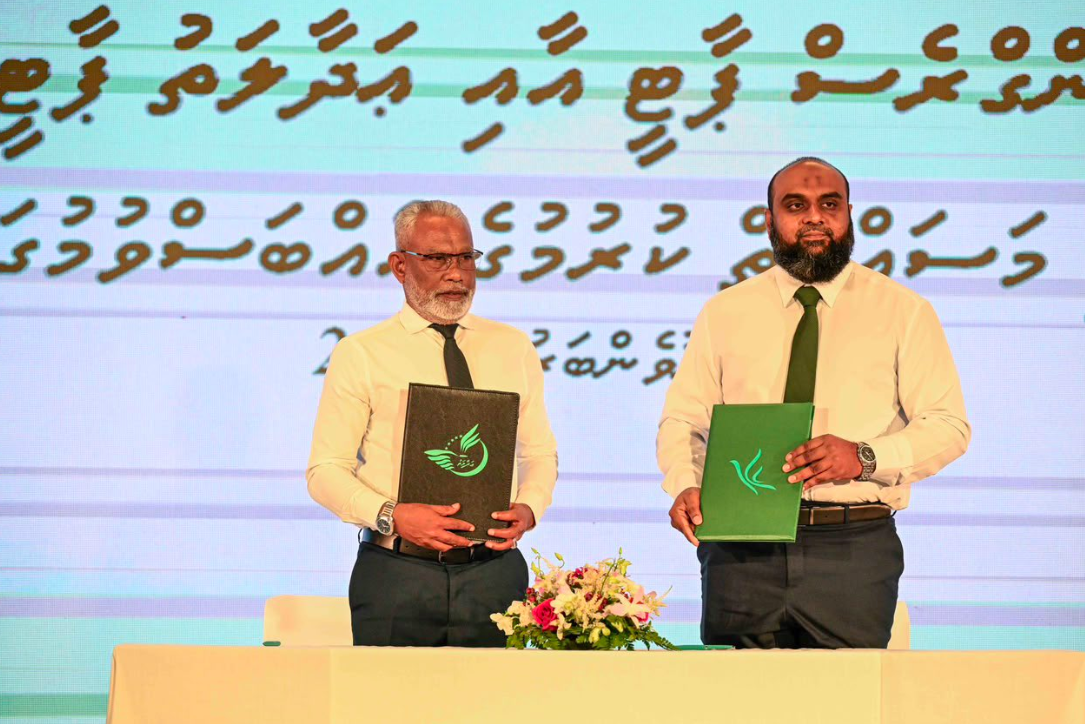
The Adhaalath Party (AP) has officially signed a coalition agreement with the ruling People’s National Congress (PNC) to work together for the remainder of the current presidential term and throughout the 2028 presidential election. Signed on Monday by PNC Chairperson and Parliament Speaker Abdul Raheem Abdulla and Adhaalath Party President Sheikh Mohamed Shifan following an official invitation from President Dr. Mohamed Muizzu, the pact marks a major realignment in Maldivian politics, ending nearly a decade of cooperation between Adhaalath and the main opposition Maldivian Democratic Party (MDP).
The formal signing followed a resolution passed by Adhaalath’s Consultative Council, in which 41 of the 47 eligible members present voted in favor of accepting President Muizzu’s invitation to enter the government as a coalition partner. Speaking after the ceremony, Speaker Abdul Raheem thanked Adhaalath’s leadership and general members on behalf of President Muizzu for agreeing to support the administration’s work. He portrayed the alliance as proof that despite efforts by political rivals to sow doubt, the country’s discerning and conscientious majority stands firmly behind President Muizzu’s policies and leadership.
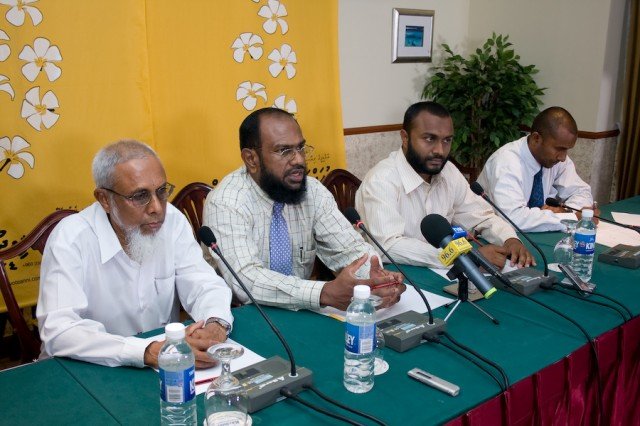
Explaining the party’s decision, Adhaalath President Sheikh Mohamed Shifan stated that the move followed extensive consultations with the party’s religious scholars, its Consultative Council, and its wider membership. According to Shifan, Adhaalath resolved to join the ruling coalition in order to reinforce government initiatives aimed at strengthening Islamic values, defending national independence and sovereignty, and stabilising the Maldivian economy.
Registered in August 2005 shortly after the introduction of multiparty democracy in the Maldives, the Adhaalath Party has historically exerted influence well beyond its parliamentary footprint, frequently acting as a coalition "kingmaker" in closely contested presidential elections. After backing former President Mohamed Nasheed in the 2008 second-round runoff, Adhaalath joined former President Abdulla Yameen’s winning coalition in 2013 before breaking away in 2015 over governance disputes, and later served as a core partner in former President Ibrahim Mohamed Solih’s MDP-led administration from 2018 to 2023.
While Adhaalath regularly criticised several policies of the Muizzu administration during its early months in office, the party’s political trajectory began to shift following its internal leadership election earlier this year. After Sheikh Mohamed Shifan secured the party presidency with 99 percent of the votes cast, Adhaalath moved steadily closer to the government—most notably by campaigning in support of the administration’s proposal to merge presidential and parliamentary elections.
On the other side of the pact, the ruling PNC enters the alliance from a position of substantial institutional dominance. Originally formed in 2019 by loyalists of former President Yameen, the party consolidated under President Muizzu and Speaker Abdul Raheem after Yameen broke away following the 2023 election to establish the rival People’s National Front (PNF). Holding a supermajority in the 93-seat People’s Majlis and boasting 74,048 registered members at the end of 2025—a figure party leaders announced at their September congress had surpassed 80,000 alongside awarding Muizzu the 2028 presidential ticket without a primary—the PNC already commands the largest organisational apparatus in the country.
The timing of the coalition agreement is particularly consequential, coming amid intense political backlash over the government’s multi-billion-dollar Rasmalé waterfront development project with UAE-based developer Eagle Hills and the accompanying Real Estate Business Bill. Opposition parties, including the MDP and PNF, have accused the administration of undermining national sovereignty through foreign real estate ownership and residency provisions, demanding a public referendum a demand President Muizzu has rejected while insisting that full sovereign control remains with the Maldivian state.
Despite the official endorsement from Adhaalath’s current leadership, the agreement has underscored a visible rift within the party’s traditional base. Former Adhaalath President and former Home Minister Sheikh Imran Abdulla remains firmly aligned with the opposition, standing alongside former President Yameen at the forefront of the "Dhivehinge Bin Dhivehinah" (Maldivian Land for Maldivians) movement campaigning against the Rasmalé deal ahead of major protests planned in Malé.
Political analysts observe that locking in Adhaalath’s support nearly two years ahead of the 2028 election offers clear strategic advantages for the Muizzu administration. In an electoral system where presidential runoffs often depend on second-round coalition arithmetic, securing Adhaalath early deprives the MDP and PNF of an experienced coalition partner, while giving the government visible backing from an Islamic party to counter opposition criticism over religion and national sovereignty.
At the same time, skeptics and opposition figures question whether the deal will dramatically shift raw vote totals in 2028. According to Elections Commission records published at the end of 2025, Adhaalath’s registered membership stood at 8,267—a modest fraction compared to the PNC’s expanding roll—and with Imran Abdulla actively mobilizing conservative voters against the administration, it remains unclear how much of Adhaalath’s grassroots support will follow the new leadership’s lead.
Ultimately, while the PNC–Adhaalath agreement marks a notable early move on the 2028 political chessboard and reinforces the ruling party’s momentum, leadership pacts alone rarely decide Maldivian elections. Over the next two years, the true political math of 2028 will depend far more on economic performance, public sentiment surrounding flagship projects such as Rasmalé, and whether a currently divided opposition can coalesce behind a unified challenger.