
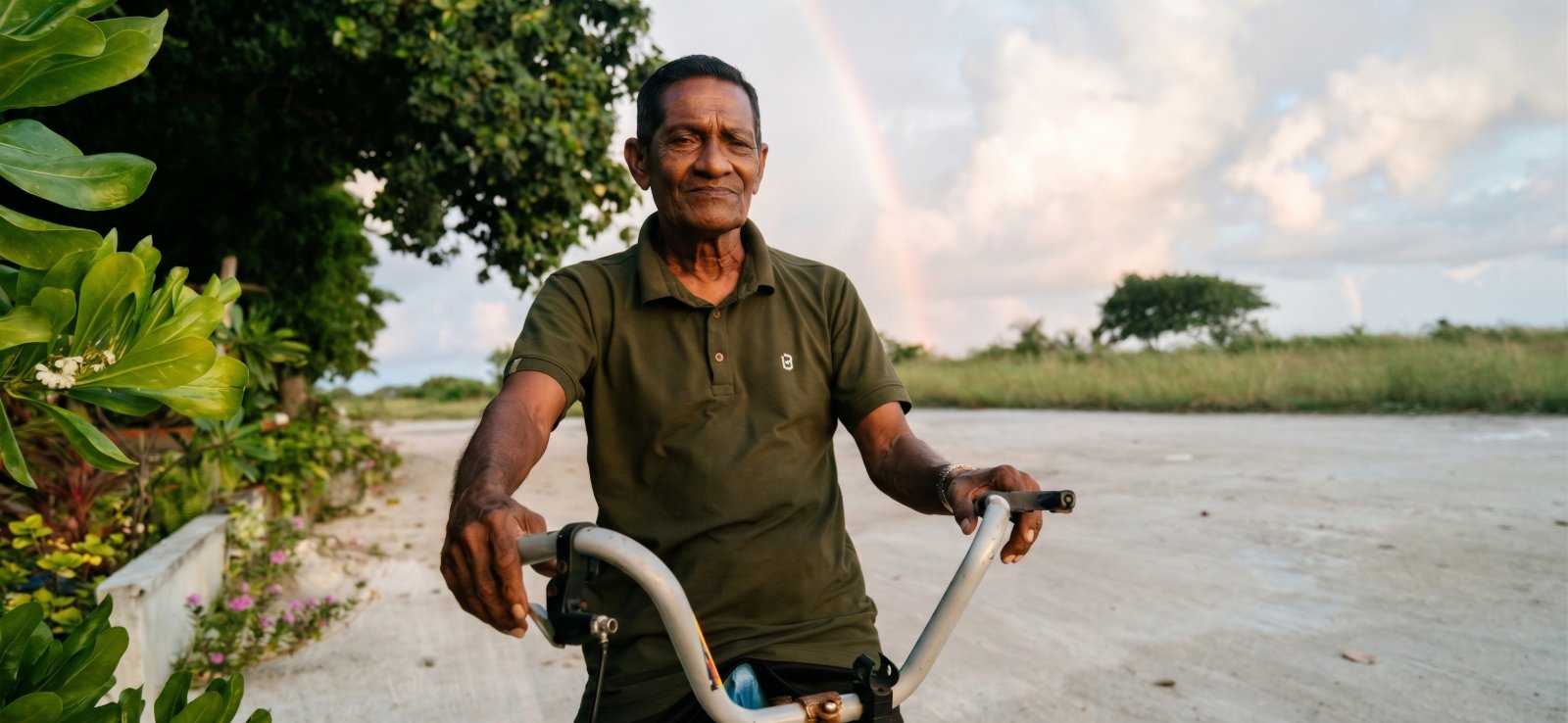
At 75 years old, Abdul Sathar Ali affectionately known across K. Thulusdhoo simply as "Sattharube" stands as a living archive of a Maldives that has largely vanished. Living at "Thilafaru," he has watched his island transform from a dense, untamed jungle into a bustling international surf and guesthouse hub. Yet, among the decades of memories etched into his mind, none is as vivid—or as spine-chilling—as a mysterious night at sea during his youth when his fishing vessel was ensnared by an unseen force.
The ordeal began on what seemed like an ordinary return trip from AA. Ukulhas, where Sattharube and his crew had gone to gather live bait. Setting sail back toward their atoll, the wooden dhoni reached the open waters between Ari Atoll and Kaafu Atoll around 5:00 PM. Although waves lapped steadily against the hull as if the boat were cutting through the water, the crew soon realised they were not moving forward at all.
As the sun dipped below the horizon and darkness settled over the ocean, the atmosphere aboard shifted from confusion to dread. Emerging from the shadows beside the vessel were large, shrouded corpses bound in five places, drifting eerily past the hull. Recognising the signs from old maritime lore, the captain grimly announced to the crew that the boat had been kandumathi elhun—cursed or trapped at sea by supernatural forces.
Moments later, the captain warned that the dhoni was running aground. To check the depth, the crew plunged a long wooden punting pole into the water, expecting to hit coral or sand. Instead, the pole met nothing but deep, empty ocean; there was no reef beneath them, yet the vessel remained locked in place.
The tension reached a breaking point when a strange orb of light suddenly materialized and ignited atop the boat's mast. Panic rippled through the older fishermen on board, who feared the vessel would capsize at any moment. Looking at the glowing mast, they asked who among them would be brave enough to climb up with rihaakuru (traditional thick fish paste)—an age-old Maldivian remedy believed to ward off sea spirits.
"I told them, 'I will climb up.' So I took the rihaakuru and climbed right up the mast," Sattharube recalled, his eyes gleaming as he recounted the memory.
No sooner had he smeared the rihaakuru on the tip of the mast and climbed back down than the mysterious light jumped to the bow of the dhoni. Sattharube rushed forward to rub rihaakuru onto the bow, only for another orb to flare up near the rigging. Each time he applied the paste and the crew hoisted the sail, the spectral lights shifted to another part of the boat.
Throughout the ordeal, the five-bound corpses continued to drift alongside the vessel, appearing to smile as they passed. While the seasoned elders aboard were paralyzed with fear, Sattharube—still a young boy at the time—found the entire spectacle oddly amusing, too young to fully grasp the peril the older men believed they were in.
When the light flared up once more at the stern and jumped back to the bow, the older fishermen lost all hope, declaring that they would not survive the night and ordering the sails to be dropped. However, as the vessel eventually drifted near Bodu Hithi within sight of the Arashu reef, the crew witnessed a final, breathtaking phenomenon: the entire reef appeared to erupt into flames, after which the haunting presence vanished as suddenly as it had arrived.
Long before such eerie encounters, Sattharube’s childhood on Thulusdhoo was defined by discipline and simplicity. Unlike children today who spend their afternoons playing along the shoreline, youngsters of his generation rarely left their homes, spending their days indoors learning to write the Thaana alphabet—Alif, Baa and Ha, Shaviyani, Noonu, Raa, Baa, Lhaviyani—on traditional wooden voshifilhaa slates.
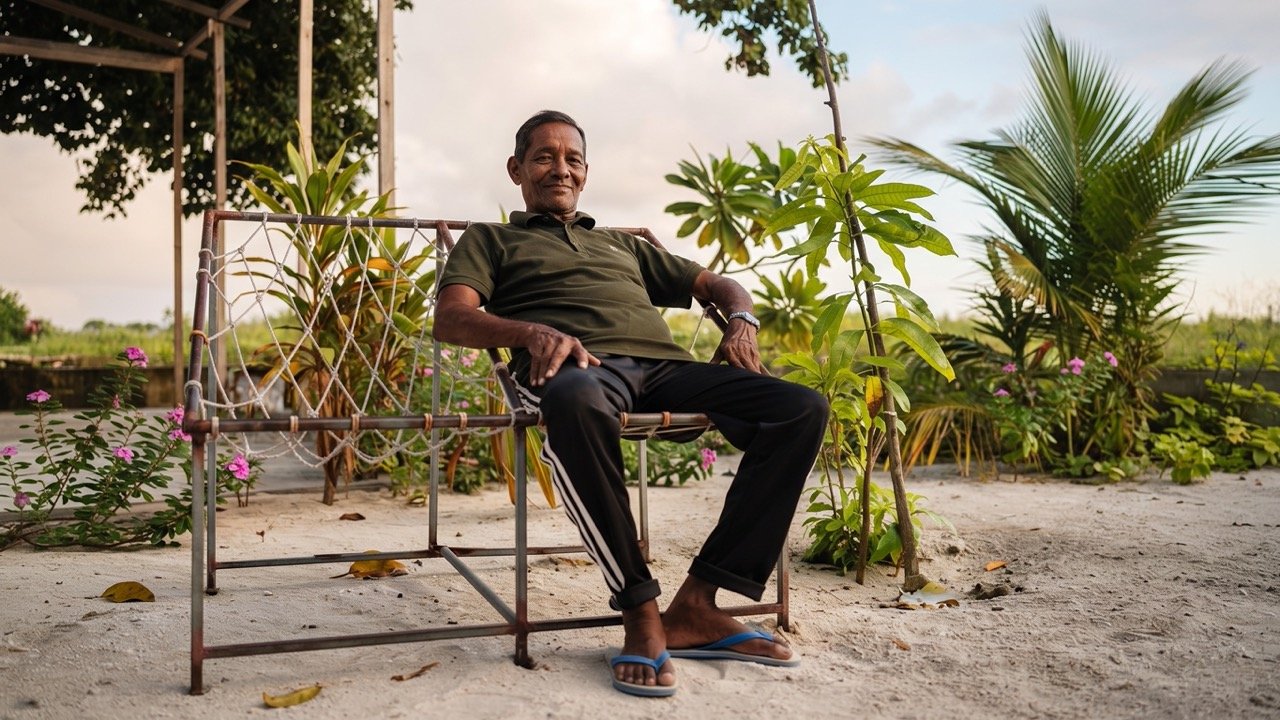
Entering adulthood meant embracing the gruelling life of a traditional fisherman in an era before motorised engines. Sattharube and his crew relied entirely on wind and wooden oars, rowing out to the nearby Mulhi fishing grounds before making the exhausting journey by oar all the way to Malé to sell their catch. From Malé, they would row to Bodu Hithi by sunset to free-dive for octopus, rowing back to Thulusdhoo by midnight—only to wake up at 4:00 AM to row back out to Mulhi once again.
Beyond the sea, Sattharube’s working life spanned decades of physical labor and public service. He spent four years and nine months working in the government’s agriculture sector before taking up construction work on Thulusdhoo. While building a warehouse on the island, a severe electric shock knocked him down, leaving him injured and unable to work for nearly two years. After recovering, he served as the captain of the Atoll Office dhoni and later worked for a year and a half during the construction of Thulusdhoo’s landmark Coca-Cola factory.
His personal life has seen both deep sorrow and quiet pride. From his first marriage, Sattharube fathered 12 children, though five passed away in infancy at just one or two months old, leaving seven surviving children. Following the death of his first wife, he briefly married a woman named Zaraana—a relative of Raagondi Nizaar from Th. Vilufushi—for about a month before choosing to remain unmarried for the rest of his life. Today, his greatest source of pride is having raised his children into upright, self-reliant adults.
Having lived through the era of President Ibrahim Nasir and witnessed every chapter of Thulusdhoo’s evolution, Sattharube looks at his island’s modern prosperity with joy. Still, seeing tourists stroll past local guesthouses often reminds him of a visit by former President Maumoon Abdul Gayoom, who once warned Thulusdhoo residents that opening guesthouses on inhabited islands would ruin the nation's youth and culture. Decades later, after President Mohamed Nasheed introduced local island tourism, Thulusdhoo flourished into one of the country's premier travel destinations.
At 75, Sattharube refuses to slow down. Every morning begins with sweeping the beachfront before moving on to tidy his own yard—a chore he repeats three times a day to clear fallen leaves. While he no longer swims in the sea, he stays active by cycling around the island on his bicycle to visit relatives and friends.
Known for his warm nature, Sattharube loves stopping to chat with visitors and strangers who arrive on the island—a habit that has led some locals to jokingly label him "crazy." Unbothered by the remarks, he lives by a simple philosophy: "I want everyone to see me as a kind person, and I treat others in the best way I possibly can." Grateful for a life where he achieved everything he set his heart on, his parting advice to today’s youth is equally straightforward: stop relying on your parents, stand on your own two feet, and build a life through your own hard work.